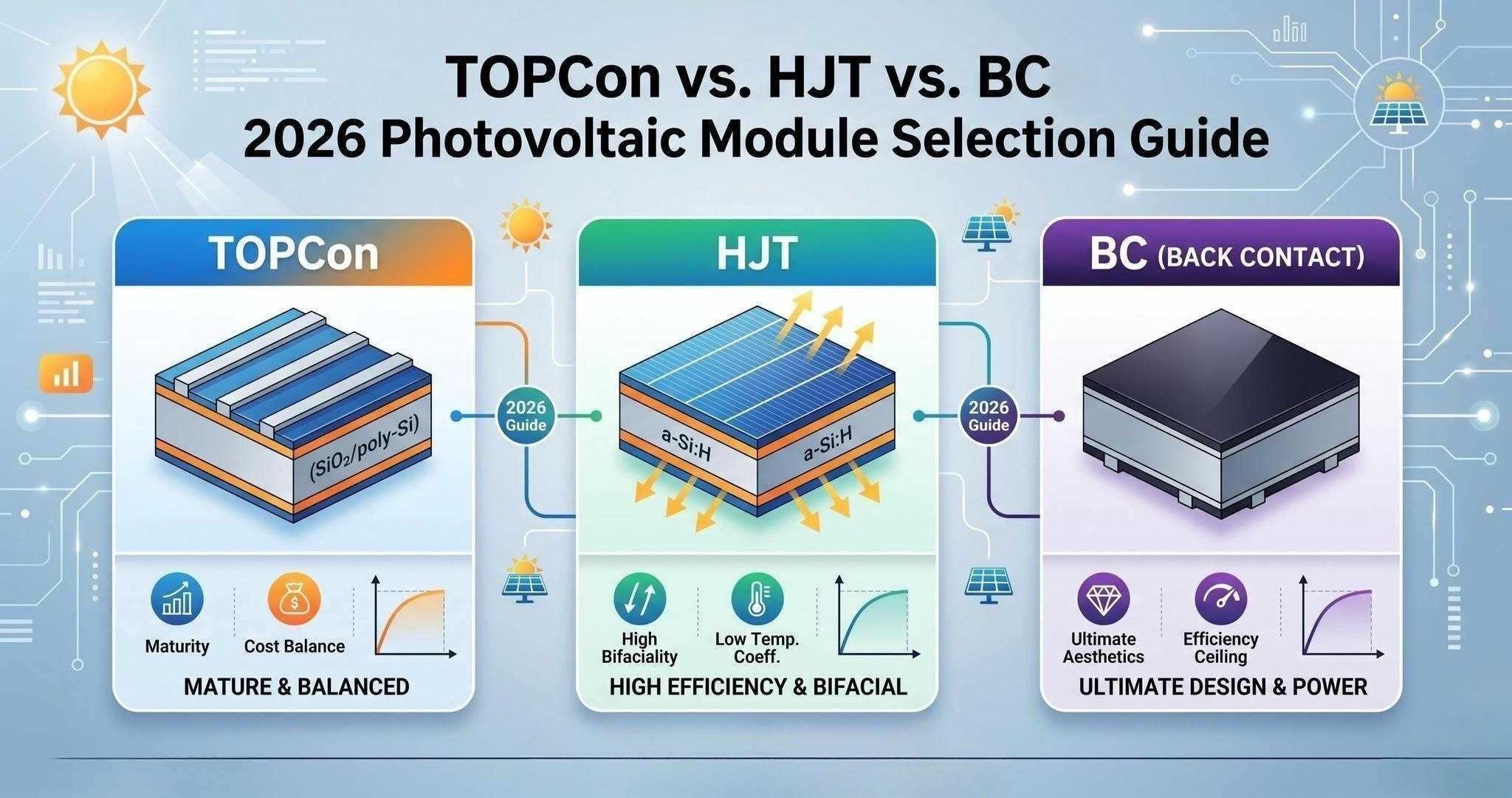
As the PV industry completes its massive transition from p-type PERC to n-type technology, three frontrunners have emerged: TOPCon, HJT, and BC. Each offers distinct advantages in performance, cost-efficiency, and application compatibility. Project developers often face the dilemma of choosing between "high efficiency at a premium" versus "superior bifaciality with standard aesthetics."
This Q&A guide analyzes the core strengths, future trends, and selection strategies for these three technologies to help you maximize your ROI.
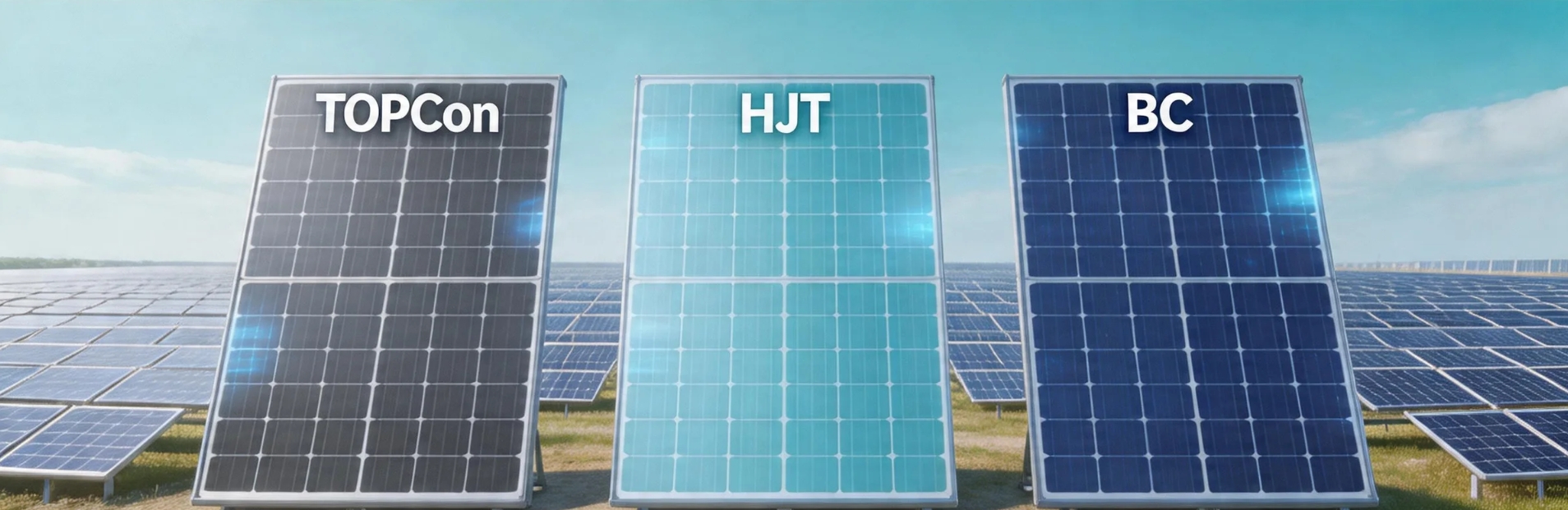
Q1: What are the core advantages of TOPCon, HJT, and BC?
1. TOPCon (Tunnel Oxide Passivated Contact)
Leading Mass Production Efficiency: Current mainstream module efficiency has reached approximately 25%, with Tier-1 manufacturers approaching 25.5%, marking a period of high industrial maturity.
Superior Cost-Effectiveness: TOPCon is compatible with existing PERC production lines, resulting in lower initial CAPEX and a highly mature supply chain.
The Balanced Choice: It offers the most competitive price-to-performance ratio for utility-scale ground stations and C&I (Commercial & Industrial) distributed projects.
Key Specs: Bifaciality of 80% ± 5%, temperature coefficient of -0.30%/°C, first-year degradation ≤1%, and annual degradation≤0.4%.
2. HJT (Heterojunction Technology)
Higher Efficiency Potential: Laboratory efficiencies have surpassed 26.8%, with mass production rapidly nearing 26% and a roadmap toward 27%+.
Maximum Bifacial Gains: HJT boasts a bifaciality of 85%–95%, roughly 5%–10% higher than TOPCon, significantly boosting power yield from the rear side.
Elite Electrical Performance: Features a low temperature coefficient (-0.24%/°C) for minimal power loss in hot climates. Exceptional weak-light response and near-zero LID/PID ensure a first-year degradation of ≤1% and annual degradation ≤0.25%.
Ideal Scenarios: Large-scale utility projects, high-temperature/high-humidity regions, and projects with high land costs where maximizing power density is critical.
3. BC (Back Contact: IBC, HPBC, ABC)
No Front Gridlines: With all electrodes moved to the rear, the cell surface is unobstructed, maximizing light absorption and providing a sleek, premium aesthetic.
The Efficiency Ceiling: Lab efficiencies have exceeded 27%, pushing the theoretical limits of crystalline silicon.
Premium Segment Dominance: Specifically designed for residential rooftops, BIPV (Building Integrated PV), and C&I facades where aesthetics and power per square foot are the top priorities.
Note: BC modules are traditionally monofacial (bifaciality <20%), requiring careful LCOE evaluation for ground-mounted utility projects.
Q2: How will these technologies evolve over the next 3–5 years?
TOPCon: Will remain the market leader with over 60% market share by 2026. Innovation will focus on rear-side passivation, SMBB (Super Multi-Busbar) fine-line printing, and thinner silicon wafers to drive costs further down.
HJT: As cost-reduction technologies like Silver-Coated Copper (SCC), copper plating, and low-indium targets mature, CAPEX will drop significantly. HJT’s LCOE advantage will become undeniable in high-tariff regions and extreme climates.
BC: Positioned as the "ultimate" silicon technology. While currently limited by process complexity, the long-term trend is to hybridize BC with TOPCon or HJT (e.g., TBC or HBC) to enable low-cost, ultra-high-efficiency mass production.
Q3: How to choose the right module for your project?
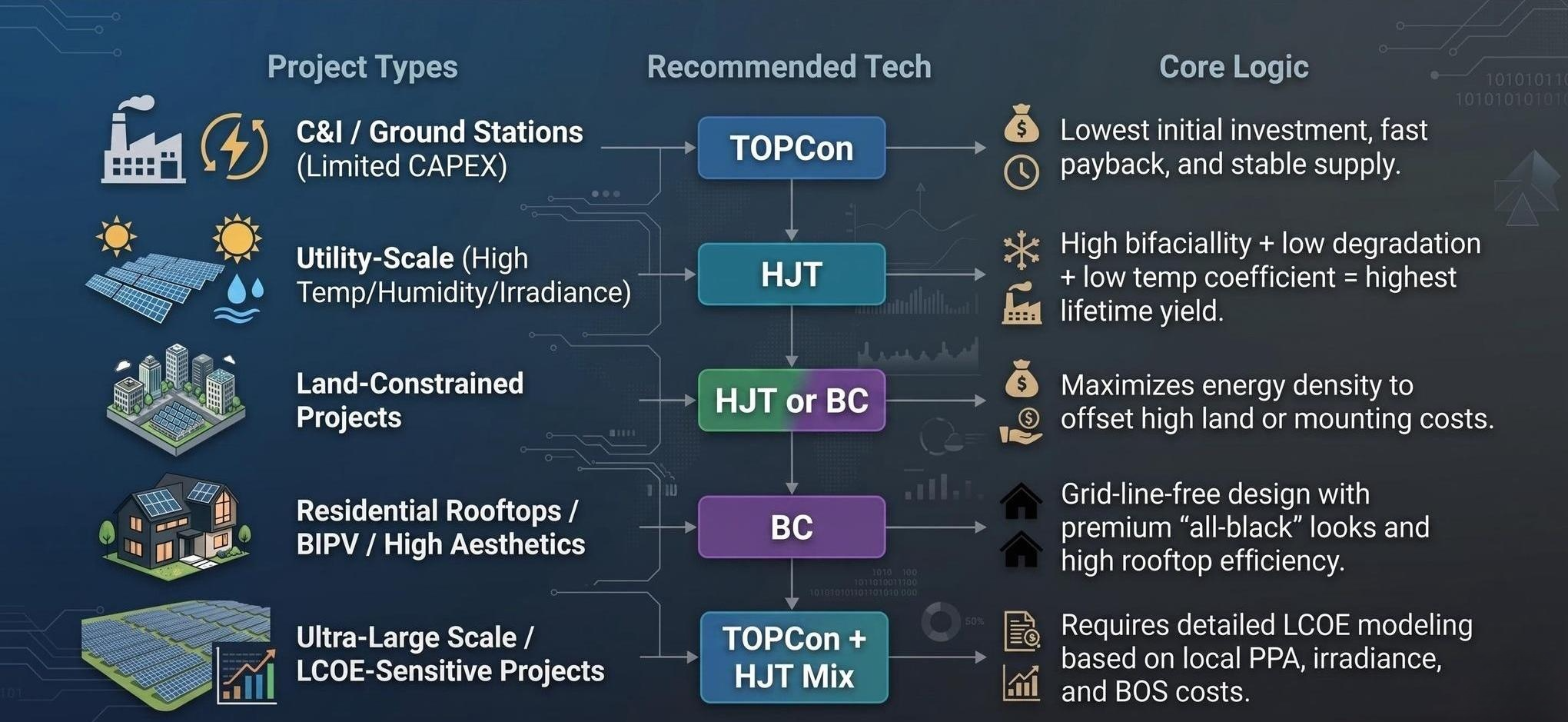
Pro Tip: For utility projects exceeding 10 MW, we recommend a full life-cycle simulation



 IPv6-Netzwerk unterstützt

 English
 français
 italiano
 español
 português
 العربية
 日本語
日本語 Polski
 ไทย
ไทย